Tech StudioCoffee LabSwitch between Simon's Tech Studio and Coffee Lab.
Loading blog…
Why I Build at the Intersection of Software and Coffee | Simon Mwangi
development•
6 min read
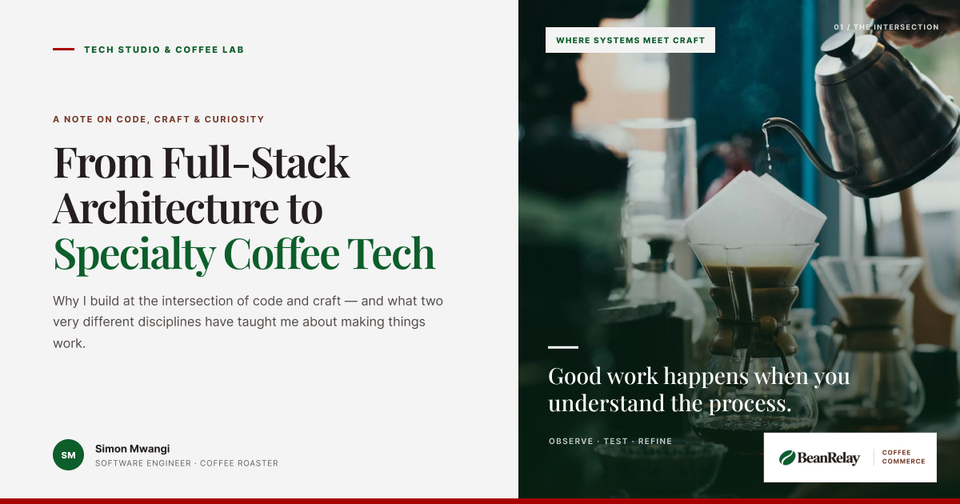
From Full-Stack Architecture to Specialty Coffee Tech: Why I Build at the Intersection of Code and Craft
Exploring the connection between software engineering and specialty coffee, and why both have shaped the way I think, build, and solve problems.
Technology and coffee might seem like two very different worlds. One involves code, databases and system architecture. The other involves coffee origins, roasting curves, extraction and sensory experiences.
But the more time I've spent working in both, the more I've realised how much they have in common.
Both require curiosity, patience, attention to detail and a willingness to experiment. Both involve working with variables, understanding how small changes affect the final outcome, and learning from things that don't always go as planned.
I'm Simon Mwangi, also known online as Wangenye. I'm a full-stack software engineer and coffee roaster based in Nairobi, Kenya. Over the years, I've found myself moving between these two disciplines, often discovering that the way I approach one influences how I work in the other.
This is where I bring those interests together: Tech Studio & Coffee Lab.
It's a space where I share what I'm building, what I'm learning and the ideas that emerge when technology meets the world of specialty coffee.
Building software that works beyond the demo
I enjoy building things. But for me, getting an application to work is only the beginning.
A website can look impressive and still be frustrating to use. An application can work perfectly during development and struggle when real users, unreliable networks or unexpected payment responses enter the picture.
That's why I care about what happens beneath the interface just as much as what people see on the screen.
My work involves building web applications, APIs and digital systems, with a particular interest in making them reliable, maintainable and practical.
I primarily work with technologies such as:
Frontend: Next.js, React and Tailwind CSS.
Backend: NestJS, Node.js and TypeScript.
Data: PostgreSQL and structured data modelling.
Integrations: Payment services and third-party APIs, including M-Pesa and Stripe.
Content infrastructure: Headless CMS solutions such as Sanity.
Working from Nairobi also gives me a practical perspective on software development. Network interruptions, delayed callbacks, payment verification and integration failures aren't just theoretical engineering problems. They're things you have to think about when building systems that people depend on.
I want to understand how an application behaves when things go wrong, not just how it performs when everything goes right.
Projects such as Bean Relay and Coffea Academy give me opportunities to explore these challenges in real-world contexts.
What coffee has taught me about engineering
My interest in coffee goes beyond drinking it.
I've spent time working with coffee roasting, cupping, flavour development and quality evaluation. These experiences have changed the way I look at processes, experimentation and consistency.
Take coffee roasting, for example.
A roast profile isn't simply a matter of following a temperature curve. You have to understand the coffee you're working with, observe how it responds to heat, pay attention to development and evaluate the result in the cup.
Changing one variable can influence the final flavour. Sometimes the result is better than expected. Sometimes it tells you that something needs to be reconsidered.
Software development has a similar rhythm.
A small change in a database query, application state or API response can affect how an entire system behaves. When something breaks, you need to understand what changed, trace the problem and work towards a solution without creating another problem somewhere else.
There are three principles I find myself returning to in both disciplines.
1. Understand the variables
In coffee, this means paying attention to factors such as green coffee characteristics, moisture, temperature, airflow and development time.
In software, it means understanding the data, dependencies, application state and external services that influence how a system behaves.
You can't make meaningful improvements if you don't understand what you're working with.
2. Build processes you can understand and improve
Good software architecture makes it easier to maintain individual components, identify problems and introduce changes without disrupting everything else.
The same thinking applies to coffee production. Recording processes, tracking changes and evaluating results makes it easier to understand why one batch performs differently from another.
Documentation isn't just paperwork. It's part of learning how to do something better.
3. Never lose sight of the person using the result
Technology should make people's lives easier, not introduce unnecessary complexity.
In coffee, the goal isn't to produce a complicated roast profile or use impressive terminology. It's to understand the coffee and bring out a quality that someone can appreciate in the cup.
Whether I'm building an interface or developing a roast, I keep coming back to the same question:
Does the final experience actually work for the person on the other side?
Where technology meets the coffee industry
This intersection is more than an interesting personal connection. It's also where some of my most meaningful projects are taking shape.
Bean Relay explores how digital commerce can better serve coffee businesses. I'm interested in the challenges roasters and coffee brands face when presenting their products, managing orders and creating a smoother buying experience for their customers.
Coffea Academy brings technology into coffee education through a digital learning platform designed to support courses, learning resources and the wider coffee community.
And beyond software, my work with roasting and sensory evaluation continues to influence how I think about quality, repeatability and experimentation.
These projects are different, but they share a common motivation: understanding a problem and building something useful around it.
What I'll be exploring here
I don't want this blog to be limited to software tutorials or coffee discussions. Both subjects have plenty of depth on their own, but I'm particularly interested in the lessons that emerge when they overlap.
You'll find articles and experiments covering areas such as:
Software engineering: Application architecture, Next.js, NestJS, APIs, databases and practical development challenges.
Payments and integrations: Working with M-Pesa, Stripe, webhooks and the complexities of building dependable payment workflows.
Coffee technology: Digital tools, e-commerce, inventory systems and the opportunities to improve how coffee businesses operate.
Specialty coffee: Roasting, cupping, sensory evaluation and the science behind coffee quality.
Building in public: Lessons, decisions, challenges and occasional mistakes from working on real projects.
I'll also share some of the things I'm experimenting with, including the decisions behind a feature, why an approach worked, and what I'd do differently next time.
A little more about the journey
I'm still learning, experimenting and figuring things out. Some ideas will work. Others will need to be revisited. I think there's value in sharing that process rather than only showing the polished result.
For me, software engineering and specialty coffee aren't competing interests. They've become two ways of understanding the world: one through systems and logic, the other through observation and sensory experience.
Both have taught me to pay attention, ask better questions and respect the process behind a good result.
If you're interested in technology, specialty coffee, or the interesting space where the two meet, you're welcome to follow along.
Let's explore, experiment and build something meaningful.